An infectious disease outbreak activates an entire public health agency at once. Each ICS role is used, including agency leadership, field operations, clinical operations, laboratory work, epidemiology, communications, legal, logistics, and more. All respond together, and the outcome depends on how well they coordinate.
The New York City Department of Health tested that coordination on November 2, with every one of its Emergency Response Groups (ERGs) in the same exercise.
The challenge: coordination across the whole agency against a complex infectious disease
Large agencies face many of the same difficulties when they prepare for a public health outbreak:
- The response crosses every function. Each group holds their part of the picture, and decisions in one group affect the work of the others.
- Plans are validated in parts. A tabletop exercise confirms that a plan is sound on paper. Carrying it out in real time, with every group active, is a separate test.
- Volume builds quickly. Requests arrive from partners, providers, and the public at the same time, and many groups receive the same questions.
- Full activations are hard to practice. Bringing 22 groups together requires planning, staffing, and a scenario detailed enough to give each one real work.
The approach: a functional exercise for all 22 groups
High Street is working with the Department on a five-year exercise series under the CDC Public Health Emergency Preparedness (PHEP) program. Each exercise builds upon the previous one, moving from plans and discussion toward real-time operations.
The series began with a tabletop exercise in December 2025, which examined the Department's response plans. This capstone functional exercise examined whether its 22 ERGs, organized in a modified Incident Command System structure, can carry those plans out together.
The design gave every ERG real work and real pressure:
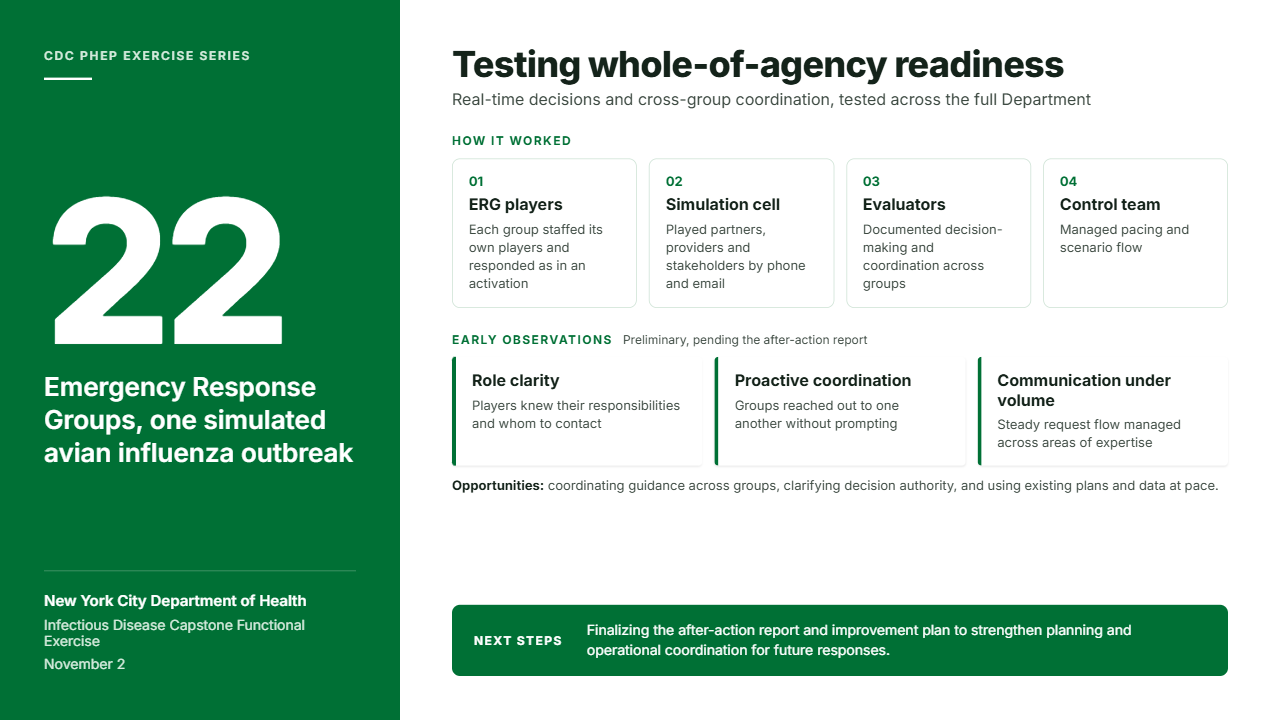
- Players: each ERG staffed its own players, who responded as they would in an activation.
- Simulation cell: a team representing external partners, providers, and other stakeholders delivered scenario information by phone, by email, and in person.
- Evaluators: documented decision-making and coordination between groups.
- Control team: managed pacing and the flow of the scenario.
Players received information, made decisions, and coordinated across groups in real time. That shows how the organization performs, alongside what its plans say.
Early observations
The after-action review is still underway, and these observations are preliminary. Three strengths stood out:
- Role clarity. Players understood their responsibilities and knew whom to contact for what.
- Proactive coordination. Groups reached out to one another without prompting. When teams split up to cover more ground, they reported back and stayed aligned.
- Communication under volume. Groups managed a steady flow of requests, clarified what was being asked, and drew on different areas of expertise to produce what was needed.
The exercise also surfaced opportunities to improve, consistent with what we see across large-scale response operations:
- Coordinating guidance when many groups field the same questions
- Clarifying decision authority across groups
- Making full use of existing plans and data once the pace picks up
What other agencies can apply
- Plan exercises as a series. Start with discussion to confirm the plans, then move to operations to confirm the organization can carry them out.
- Activate every group at least once. Coordination between groups can only be observed when all of them are working at the same time.
- Use a simulation cell. Realistic calls and emails from outside the agency create the volume that tests communication.
- Evaluate the connections between groups. Assign evaluators to watch how information and decisions move across the organization.
- Settle common questions in advance. Agree on who issues shared guidance and who holds decision authority before the pace picks up.
If your agency is planning an exercise series or a full activation, get in touch. You can also read more about our functional and full-scale exercise support and multi-year exercise programs.